
A small business is ready for PR when three things are true: you have a clear business goal that being in the news would move, you have something new and provable to say, and you can give a PR firm a few hours of your week for at least three months. If any of those is missing, fix it first. That’s the short version of what three people who run PR firms told us when we asked them about PR for small business: Janet Falk of Falk Communications and Research, Kelly Fletcher of Fletcher Marketing Communications and Ethan Rasiel of Lightspeed PR.
We build websites and run SEO for small businesses, so we usually meet owners at the other end of this decision. Somebody got a mention in the paper, the phone didn’t ring, and they want to know why. Often the website wasn’t ready for the people who went looking. So we asked the PR side when an owner should make the call in the first place.
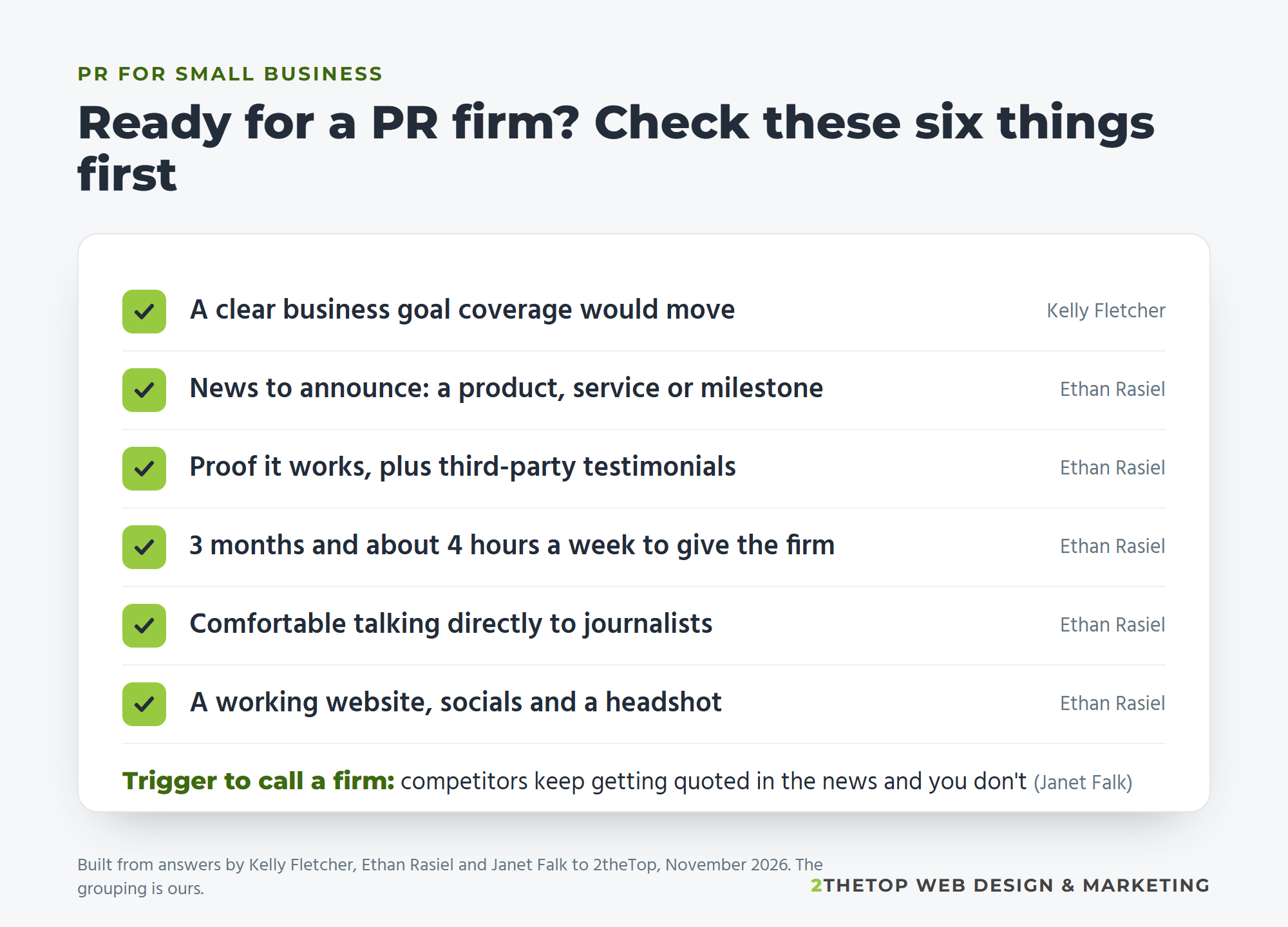
Three PR firm owners on when a small business is ready
We asked each of them one question by email. Their answers are below, in their own words. They don’t all agree on timing, and that’s useful.
Janet Falk on the one sign you’re ready
Janet runs Falk Communications and Research in New York. She works on media relations and marketing communications for attorneys, business owners and consultants, which means her clients are mostly people selling their own expertise. We asked her for the one sign a small business is ready for PR.
The one sign a small business is ready for PR is when they learn their competitor is being featured in other news stories and they are not. Reporters call the people they know. They do not call business owners they never heard of. If being in the news will help you grow your business, you have to professionally introduce yourself to reporters whose publications will put you in front of your target audiences.
It won’t happen overnight, but it won’t happen if you don’t start soon.
Janet Falk, Falk Communications and Research
Her test is easy to run on yourself. Search your competitors’ names in Google News. If they keep turning up as the quoted expert and you never do, reporters already have a short list, and you aren’t on it.
Kelly Fletcher on starting earlier than you think
Kelly is CEO of Fletcher Marketing Communications, an award-winning PR and marketing firm whose client list runs through hospitality, healthcare, financial services and insurance. Her answer pushes back on the owner who thinks PR is for big brands.
The best time to hire a PR firm is earlier than most small business owners think. You don’t have to be a Fortune 500 brand to benefit from public relations. In fact, building awareness, credibility and trust can give small businesses a significant advantage. A PR professional can help define your story, identify the right audiences, establish a strong market presence and create opportunities for meaningful media exposure. The key is having a clear business objective and a willingness to invest in building your reputation. Don’t expect people to know your name. Start giving them a reason to.
Kelly Fletcher, CEO, Fletcher Marketing Communications
Ethan Rasiel on when not to hire a PR firm yet
Ethan has been CEO of Lightspeed PR since 2013. The firm does PR and marketing for technology companies, turning technical products into stories a reporter will run. He chose to answer from the other direction, with the reasons to wait. He also told us he wrote it himself, without AI.
Don’t bring in a PR firm if:
- You can’t provide tangible proof to the media that your product/solution is real and really works.
- You can’t commit to at least three months of work.
- You can’t provide at least 4 hours per week (10% of your time) to review their work and give them the info they need.
- You have no third party testimonials (can be customers, experts, partners, etc)
- You have no news (new product, new solution, milestones, etc)
- You aren’t comfortable talking directly to journalists
- You expect immediate coverage in the Wall Street Journal or similar – building to that takes time
- You don’t have your other marketing ducks in a row – you need a viable website, socials, collateral, headshot, etc.
Ethan Rasiel, CEO, Lightspeed PR
Start the groundwork early and hire the firm when you have news
Kelly says start earlier than you think, and Ethan gives you eight reasons to wait, but both answers point at the same thing. Kelly’s condition is “a clear business objective and a willingness to invest.” Ethan’s list is what that willingness looks like in practice: proof, news, time and a story you’re comfortable telling a journalist.
So here’s how we’d read the three answers together:
- Start the groundwork now. Collect testimonials, write down what makes your work different, get a decent headshot and fix your website. None of that needs a PR firm, and all of it is on Ethan’s list.
- Watch for Janet’s trigger. When competitors keep getting quoted and you don’t, the gap is already costing you. That’s the time to talk to a firm.
- Hire when you have something to announce. A new service, a location, a milestone, a result you can prove. A firm with nothing to pitch is billing you to wait.
- Budget for a quarter, minimum. Ethan’s floor is three months and about four hours of your own time each week. If you can’t give that, a firm can’t do its job.
That list is our reading of their answers. If you run a business with no news and no time to spare, the cheaper first step is often the work we cover in when to use SEO, PPC, social, email or print.
Your website has to be ready before the coverage arrives
When a story mentions you, most readers won’t click a link in the article. They search your business name later, and they land on whatever Google and ChatGPT show for it. We wrote about how that shows up in your reports in branded traffic: those searches get counted as organic visits, even though the press coverage earned them. If the site they find is thin or out of date, the coverage you paid for leaks away.
Ethan’s last point covers this: “a viable website, socials, collateral, headshot.” Here’s what we check before a client’s PR push goes live:
- An about page a reporter can use. Your name, your role, a current headshot, a two-line bio and how to reach you. A reporter on deadline needs all of that in one place.
- One page per service. A reader who hears about you in a story wants to know if you do the thing they need. Our list of web design mistakes that cost you leads covers the common gaps.
- Proof on the page. The same testimonials Ethan wants you to hand a journalist belong on your site, next to the service they describe.
- A clean first page for your name. Search your business name plus “reviews” and see what a new prospect sees. Our online reputation management tips walk through what you can control there.
- A way to contact you that works on a phone. A form that submits, a number you can tap, an inbox someone reads.
If the site needs more than a tune-up, that’s the job our web design team does every week, and a PR push is a good deadline to hang it on.
PR builds the mentions that search engines and AI assistants read
Good press does two jobs for search. The article itself often links to you, and those links are the hardest kind to fake. We cover the rest of that in link building for small businesses. It also puts your name next to your topic on sites other people trust, and that’s what ChatGPT and Google’s AI answers pull from when someone asks who to hire. Our GEO work starts from the same idea.
We can’t promise a number here. One placement in a trade publication can bring in a client, and ten placements can bring in nothing if they reach the wrong readers. That’s why Janet’s phrase matters: reporters “whose publications will put you in front of your target audiences.” Pick the readers first, then the outlets.
PR for small business: questions to answer before you call a firm
Before you sign a retainer, answer these honestly. What business goal would coverage move, and how would you know it moved? What’s your news this quarter? Can you name three customers who’d vouch for you on the record? Will you take a reporter’s call with a day’s notice? And when someone reads about you and searches your name tonight, what will they find?
If that last answer makes you wince, start there. Get in touch with us and we’ll look at your site before the first story runs.
 About