
Pick a digital marketing channel by asking where your buyer is right now. If they’re already searching for what you sell, use search: your Google Business Profile, SEO and pay-per-click ads. If they already know you, use email and social to bring them back. If they’ve never heard of you, you need awareness, and that’s where community and even old-fashioned media still earn their keep. Most small businesses get this backwards and post coupons on Facebook to people who aren’t shopping.
Here’s how we decide, with our own numbers on the table, including the ones that don’t make us look good.
Start with intent, not with the channel
Back in 2013 we ran a meetup on this exact question, built around a chart from Moz Local (then GetListed.org) that sorted 22 digital marketing options on two lines: new customers versus existing ones, and building a brand versus making a sale.

The chart is old. The logic isn’t. Social media sits with existing customers and brand building, because people go there to talk to friends, not to hire a lawyer. Search sits with new customers and sales, because someone typing “roof repair near me” has a problem today. A survey from the same period found small business owners using Facebook mostly for customer acquisition, while consumers said they’d almost never start a search for a professional service on social media. That gap is where a lot of marketing budgets go to die.
So before you pick anything, answer two questions:
- Who am I trying to reach? People who don’t know me, or people who already bought once?
- What do I need them to do? Remember me later, or call me this week?
Search catches people who are already looking
For a local business, search mostly means the map results. Here’s where our own Google clicks landed over the last three months:
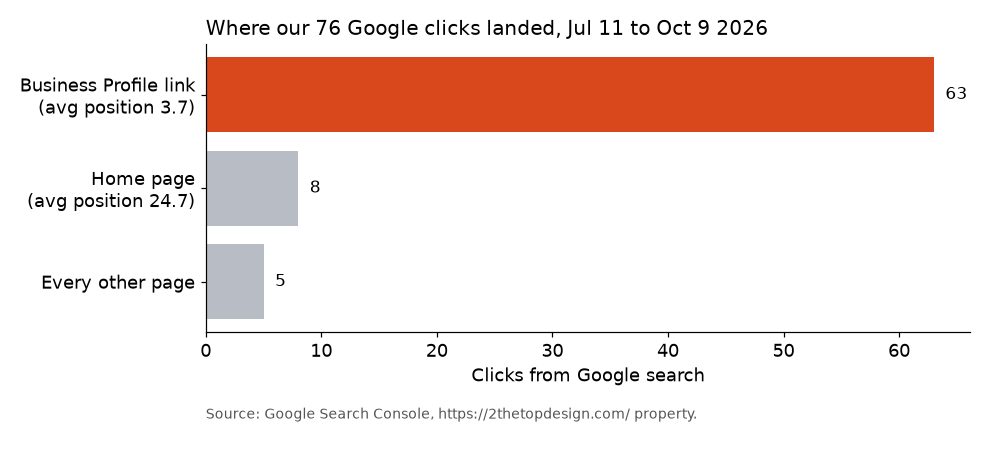
63 of 76 clicks came through our Business Profile. Meanwhile, “nashville web design” showed our website 21,267 times in 16 months at an average position of 8.4 and earned 12 clicks. That’s the organic side of search working badly, and it’s common. We cover the map side in our local SEO strategies guide.
Within search, you choose between earning the click and buying it:
| SEO | Pay-per-click (PPC) | |
|---|---|---|
| When results show up | Months | The day the campaign goes live |
| What happens when you stop paying | Rankings fade slowly | Traffic stops that day |
| Best for | Terms you’ll want for years | Testing, seasonal pushes, new sites with no rankings yet |
| Main risk | Waiting on work that never ranks | Paying for clicks that never convert |
Our judgement, not a measured result: when you already have impressions for a money term but almost no clicks, like our 12 out of 21,267, that’s the strongest case for a small, tightly targeted PPC campaign. Ads can buy the click while the organic work catches up, and the ad data tells you which searches actually turn into calls before you spend months chasing them with SEO. That’s how we run pay-per-click management for Nashville businesses. If you want to put a dollar value on a ranking before choosing, read how much a Google ranking is worth.
Measure sales, not traffic
Every channel looks good if you measure the wrong thing. Drew Dorenfest came to SEO from editing Hollywood trailers, and he puts it better than most marketers:
“Conversions are the only metric I care about. Traffic is nice, but conversions, more sales is something that the business owner can feel.”
Drew Dorenfest, on Unscripted SEO
Here’s an honest look at our own Google Analytics. In the last 12 months the site logged 1,973 sessions. 1,394 were “direct,” heavy from data-center towns like Ashburn, Virginia and Boardman, Oregon. 265 of the 288 referrals came from one spam domain. Nashville, our actual market, showed 91 sessions. And no conversion was set up at all, so every report read zero. If we’d judged our marketing by sessions, we’d have been celebrating robots.
Before you spend a dollar on any channel, set up one conversion you trust: a form submission, a tracked call, a booked appointment. Then compare channels on that. Our guide to using Google Analytics like a pro walks through it. Jeremy’s rule here is that it’s easier to unblock a dammed creek than to pour more water into the river. Fix the leak between visit and lead before you buy more visits.
Old media isn’t dead, it’s underpriced
We wrote in 2012 that the internet had gutted newspaper advertising, and the numbers backed it: inflation-adjusted print ad revenue fell from about $63.5 billion in 2000 to under $20 billion by 2012, per Newspaper Association of America data. That’s still true. But “the money left” isn’t the same as “it stopped working.” When everyone leaves a channel, the ones who stay get noticed.
Matt Tyner runs marketing for one of the largest family-owned roofing contractors in the country, and his background is digital. He still said this:
“We’ve over-rotated to digital and forgot what built the reputations that the business thrives on.”
Matt Tyner, on Unscripted Small Business
His company sponsors parades, little league banners and community events. Ours ran a free monthly SEO meetup for years, and that’s where most of our 33 Google reviews came from. Offline work feeds online signals. Jeremy calls it the digital shadow: the bigger and busier your real-world business is, the bigger and more believable the shadow it casts online.
A few ways to connect the two:
- Put a QR code on everything printed. In 2011 we wrote that QR scanning was up 800% and you needed a special app. Now every phone camera reads them. Point the code at a specific landing page, not your home page, so you can count the scans.
- Turn every event into content. Photos, a recap, a short video. One afternoon becomes a blog post, a social post and an email. Here’s how to repurpose content so it keeps working.
- Look past “SEO” for reach. On a 2014 Hangout with Bill Slawski and Jake St. Peter, Jeremy’s list of quick wins included niche forums, journalists covering your beat, and event listing sites. The channels changed names; the habit of looking sideways didn’t.
One more lesson from Bill Slawski, from a 2013 post we wrote about a journalist who read a ten-year-old Google patent as breaking news: be skeptical of anyone who claims to know exactly what Google likes. Test it on your own numbers.
Match your goal to a channel in five minutes
If you only take one thing from this page, take this table. Find your goal on the left, start with the channel in the middle, and judge it by the measure on the right. You don’t need all of them. You need the one that fits what you’re trying to do this quarter.
| Your goal | Start with | Judge it by |
|---|---|---|
| Get calls from people searching near you | Google Business Profile, then local SEO | Calls and direction requests from the profile |
| Get leads this month while SEO builds | Pay-per-click on a few high-intent terms | Cost per lead, not cost per click |
| Rank for terms you’ll want for years | SEO and useful content | Leads from organic search, quarter over quarter |
| Bring past customers back | Email, then social | Repeat purchases and referrals |
| Get known in a town that’s never heard of you | Community events, sponsorships, print with a QR code | Branded searches and new reviews |
Notice what’s missing: likes, followers, sessions. Those can tell you a channel is alive. They can’t tell you it’s paying for itself.
So which of your channels is actually producing a lead you can count, and which one are you keeping because it feels busy? If you’d like help sorting that out, send us what you’re running now and we’ll tell you where we’d start.
 About
About
I’m looking forward to learning more about the various means of digital marketing from Ross.
Hi George, we’ve already got 118 RSVP’s for the Digital Marketing presentation. Make sure you show up early to get a good seat!