
You probably have an email like this one sitting in your inbox right now. “One way link building package. 50 links for $200.” Delete it. Links still matter to Google, but the ones you can buy by the hundred are the ones that get a site in trouble, and the ones that actually move rankings have to be earned from people who know your business exists.
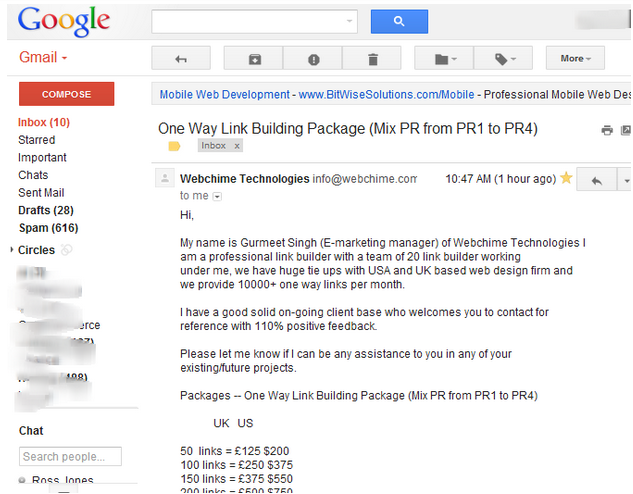
Here’s how link building works for a small business in 2026, what we found when we pointed the same tools at our own site, and five ways to earn links in Nashville that don’t need an outreach budget.
Google still reads a link as a recommendation
A link from another website is a vote that your page is worth sending people to. That idea is older than Google. What Google added in 1998 was weighing the vote: a link from a trusted, relevant site counts for a lot, and a link from a page built to sell links counts for nothing, or worse.

Relevancy comes mostly from what’s on your page. Authority comes mostly from who links to it. For each individual link, the things that decide whether it helps you are:
- Relevance. Does the linking site cover something your customers care about?
- The editorial decision. Did a person choose to link to you, or was the link sold, swapped or auto-generated?
- Anchor text. The clickable words. Natural profiles are mostly your brand name and plain phrases, not your money keyword over and over.
- The page around it. One link in a real article beats one link in a footer list of 300.
Plenty of people still search for what Matt Cutts, Google’s old head of web spam, said about links. That search still sends impressions to this page. His 2014 line on guest blogging, “stick a fork in it”, was about guest posts done purely for links. The rule underneath it hasn’t changed since: if the only reason a link exists is to move your rankings, Google would rather not count it.
Relevance beats any third-party score
Every SEO tool sells a number for a website’s strength: DA, DR, Trust Flow. Those numbers are the tool company’s estimate, not Google’s. Bradley Benner, who runs the white-label link service Semantic Links, told us on Unscripted SEO that he spent years testing before landing on this:
“It’s not some stupid third party metric like DA or DR or trust flow or anything else that matters about whether a link is valuable or not. What matters is whether it’s relevant.”
Bradley Benner, Unscripted SEO
For a Nashville plumber, a link from the Nashville neighborhood association, a supplier’s dealer page or a local news story about a job beats a link from a “high authority” general blog in another country. You can check a prospective link yourself with three questions:
- Is the linking site a real business, school, group or publication with real readers?
- Do its readers overlap with your customers, by topic or by town?
- Would you want the link if Google didn’t exist, because it might send you a customer?
Three yeses and it’s worth chasing. A no on the first question and walk away.
What we found when we checked our own link profile
We pulled 2theTop’s backlink profile through OpenSEO (DataForSEO data, 11 October 2026). The site has 521 backlinks from 232 referring domains, and some of them are exactly the links you want: Belmont University, WordCamp, WP Nashville and Moz. Links like those come from teaching, speaking and showing up at things like the free Nashville SEO meetup, not from asking for links.
Two things in the same report are less flattering, and you’ll likely find both on your own site:
- 475 of the 521 backlinks point at pages that return an error. Years of deleted and renamed posts meant good links were landing on dead URLs. That’s why we’re consolidating old articles like this one and redirecting retired URLs to the closest live page. A redirect is the cheapest link building there is, because the link already exists.
- A batch of junk directories showed up. Eight “SEO directory” sites with high spam scores were first seen linking to us within the same five days in September 2025. Links like these tend to arrive uninvited, and either way you want to spot them, which is why you look at your profile a few times a year instead of never.
Referring domains also slid from 263 to 224 over the twelve months to September 2026. Links decay when the pages holding them get deleted. Earning links is a habit, not a project.
Five ways to earn links without a budget
Jeremy Rivera, our director of digital marketing from 2014 to 2022, has run every one of these for clients. None of them need a link-building vendor.
1. Ask for attribution, not a link
If another site uses your photo, chart or quote, ask them to credit the source. Jeremy has run expert roundups since around 2010: collect quotes from practitioners, turn them into a graphic, send each contributor the finished pieces, and ask for attribution. Asked that way, people link back about 8 times out of 10. Asked for “a link”, they mostly ignore you.
2. Send something on paper
At Raven Tools, Jeremy looked up ten agencies’ street addresses and hand-wrote letters asking for their opinion for an article. Ten letters, ten links. Mike Montague of Avenue9 made the same point about mailing a printed book chapter with a handwritten sticky note:
“Nobody gets a printed book in the mail, nobody gets a handwritten note, and nobody understands their business well enough.”
Mike Montague, Unscripted SEO
3. Do things in the real world that get written about
Jeremy calls your website the digital shadow of your actual company. Sponsor the Little League team, teach a class, run a cleanup day, host a free meetup. Each of those produces a page on someone else’s site that names you. A business doing nothing offline has nothing for anyone to link to.
4. Get your partners to list you
Suppliers, manufacturers, associations and the chamber of commerce often keep “where to buy”, “certified installer” or member pages. You already qualify. You just haven’t asked.
5. Be a podcast guest
Every podcast appearance comes with show notes, and most show notes link to the guest. You also get a recording you can repurpose (see how to recycle, repurpose and reuse your content).
Links or social shares? They do different jobs
Back in 2012 we told readers to chase both, and that still holds, for a different reason than we gave then. A share on Facebook or LinkedIn doesn’t pass authority the way a link does. What it does is put your page in front of the people who write blogs, run newsletters and report the news, and some of them link. Today it also feeds the AI tools. ChatGPT and Google’s AI answers lean on what the wider web says about you, and a mention without a link still counts there.
Rob Bonham put it plainly on Unscripted SEO when he talked about what wins the search results over the long run:
“Whoever has the bigger footprint and the more people talking about them across the web in a positive way, that is the ultimate…”
Rob Bonham, Unscripted SEO
The shortcuts cost more than they save
Jeremy learned this one personally. Early in his career a site he worked on was hit with a penalty for reciprocal links (the “I’ll link to you if you link to me” swap), and he had to hire help to dig out of it. The cleanup took longer than the links ever paid back.
These tactics either stopped working years ago or carry real risk now:
- Reciprocal link swaps and link exchanges
- Paid link packages, like the email at the top of this page
- Free directories and “SEO directory” networks
- Blog comment and forum signature links
- Guest posts written only to place a keyword link
- Networks of sites you own that all link to each other
If you inherited a site with a dirty link profile, the fix is a disavow file and a weekly check, not a one-time cleanup. Jeremy once worked a door-manufacturing niche where every site in the top ten was being hit with junk links from about ten new domains a month. Rankings only came back once each new batch was spotted and disavowed, every week.
Want someone to look at your link profile with you? Start with our SEO package. Make sure the page earning the link deserves it first, so start with on-page SEO, then read our SEO tips for business blogging for content people want to link to, and how much a Google ranking is worth to decide how much effort it deserves.
So here’s the question to start with this week: who in Nashville already sends you customers, and have you ever asked them to say so on their website? Tell us who’s on your list and we’ll help you work it.
 About
About
Leave a Reply
You must be logged in to post a comment.