
On-page SEO comes down to one sentence Ross Jones put on an infographic for our Nashville SEO meetup back in 2012: put the right words in the right places. Find the words your customers actually type (that’s keyword research), then put them where Google and people both look first: the title, the headline, the URL, the headings, the images and the links. Everything else on this page is detail on those two steps.
Find the right words before you write a single title
Keyword research is just listening at scale. You want the phrases people use when they’re ready to hire or buy, in their words, not yours. Ross drew it as four steps in 2012, and the steps haven’t changed even though the tools have:

- Brainstorm. Write down what customers say on the phone, in emails and in reviews.
- Research. Look at the pages already ranking. What words do they use in their titles and headings?
- Analyze. Keep the phrases with real demand, a fair fight and buying intent, and that match what you actually sell. “Flags for sale” beats “free flag pics” every time.
- Check with tools. Google Search Console tells you what you already show up for. Keyword tools estimate the rest.
Two of the tools on that 2012 graphic are gone (Google Instant and the old Keyword Tool), and Webmaster Tools is now Search Console. The thinking holds. Jeremy Rivera, our director of digital marketing from 2014 to 2022, goes a step further: the best keyword research is a conversation. Talk to the salesperson or the customer, record it, and the questions they ask are your headings.
The right places: six spots that carry the weight
Here’s the 2012 version of where the words go:
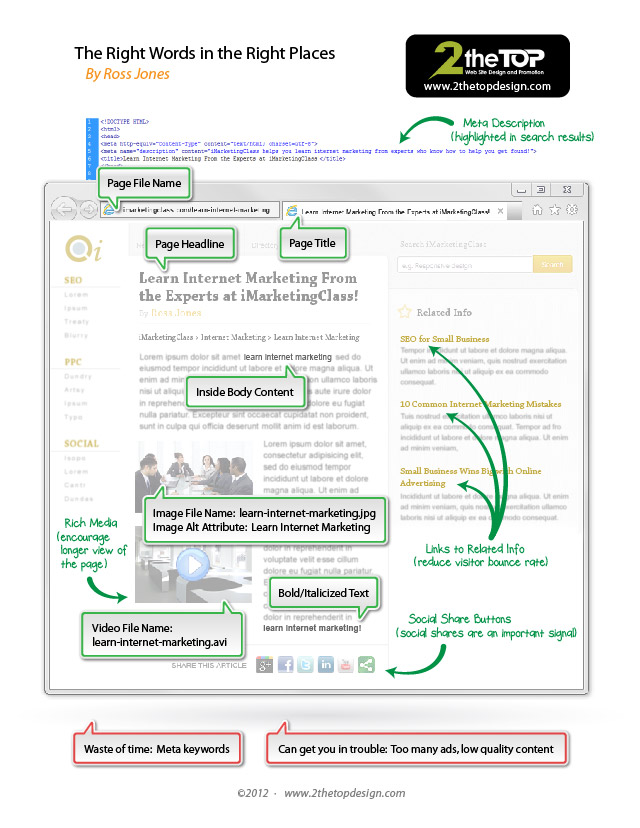
Bradley Benner of Semantic Mastery boiled the same idea down to six elements when he came on Unscripted SEO: the URL, the titles (which have two parts, the SEO title and the H1), the H2 headings, the H3 subheadings and below, the media, and the internal links. Here’s what each one needs from you:
- URL. Short and readable.
/nashville-roof-repair/, not/?p=2741. - SEO title. The blue link in Google. Lead with the phrase, keep it under about 60 characters, and say who you are and where.
- H1. The headline on the page. Same idea as the title, different words.
- Headings. Each H2 should make a claim a skimmer could act on, not a label like “Services”.
- Media. Descriptive file names and alt text that says what the image shows.
- Internal links. Link from related pages using the words someone would search, never “click here”.
The meta description isn’t a ranking factor, but it’s your ad copy in the results, so write it as a reason to click. And skip the meta keywords tag. Google has ignored it for years.
The title is for the bots, the H1 is for people
The most useful thing Bradley said is about how those two titles divide the work:
“The SEO title, the meta title is for the bots… But the H1 is for the human visitor.”
Bradley Benner, Unscripted SEO
His advice is to write the SEO title as a plain statement (who we are, what we do, where we do it) and then restate those ideas in the H1 with different words and a bit of headline copywriting. Restate, not repeat.
Jeremy calls this the human-bot-human sandwich. You’re not writing for a robot and you’re not writing only for a person. You’re writing for a bot that decides whether to hand your page to a person. The bot needs structure. The person needs a reason to keep reading.
What we found when we checked our own homepage
We ran this checklist on 2thetopdesign.com on 11 October 2026, and it’s a useful example precisely because it isn’t perfect.
Search Console shows the homepage appeared 21,267 times for “nashville web design” between June 2025 and October 2026, at an average position of 8.4, and earned 12 clicks. The Business Profile version of the same URL sits around position 3 to 4. So Google already connects us with the phrase. The page just isn’t winning the click.
Here’s what the checklist turned up:
- The title is “Not Your Typical Nashville Web Design Company”. The phrase is in there, but it starts four words in, behind a negative.
- The H1 is word-for-word the same as the title, so we’re spending both slots on one line instead of restating.
- The meta description misspells WordPress.
- Two of the eight images have no alt text.
None of that is fatal. All of it is the kind of thing an SEO audit exists to catch, and we’d rather show you ours than pretend the cobbler’s kids have shoes.
Google’s own white-hat rules, and what’s changed
In 2012 we ran a whole meetup on Google’s SEO Starter Guide. Its advice still reads well: make pages for people, organize the site so it’s easy to move around, write content that’s relevant and unique. The newer version of the same guide is shorter and blunter. Google’s current starter guide is worth an hour of your time.
What’s changed is who does the typing. Jeremy once charged a client $2,000 to hand-write every meta title and description on their site, because they wanted every one bespoke. He wouldn’t sell it that way today. AI can draft those in minutes, and a person should spend the time checking them. Rob Bonham said the same on Unscripted SEO about fixing meta descriptions and title tags by hand:
“That’s not where SEOs are gonna be spending their time moving forward.”
Rob Bonham, Unscripted SEO
Jeremy’s own 200-point audit checklist from 2012 is down to about ten items that still need a human. The right words in the right places is one of them, because a tool can fill the slot but it can’t tell you which words your customers use.
Want the tools side? Read the four SEO tools you need to know and how to use Google Analytics 4 and Search Console. If your site runs on WordPress, learn WordPress SEO covers where these fields live, and the web design mistakes that hurt SEO covers the problems a checklist won’t fix.
Open your own homepage right now. Does the title start with the words your customers type, and does the H1 say it differently? If you’re not sure, send us the URL and we’ll tell you what we’d change first.
 About
Hello Ross,
I need to apologize for the delays on getting back to you. And worse yet, after I got so far behind, I gave up thinking about our quest for for a wesite re-design and optimization. Especially since that I have been traveling so much lately, which is really a good thing since in my business, that is a good problem to have.
I do have a question however. The last meeting prior to the “Perfect SEO” meeting, I noticed that you were filming the meeting. Any chance that you filmed the “Perfect SEO” and it is available to review? If I am in town on the 23rd(?), I would like to attend the next meeting.
Thank you again,
Michael Sams
HI Ross,
I’ve briefly taken a look at two of your docs listed in Small Biz Nation and already feel more informed – thank you.
Kind regards
Roz Bishop
Do you have any workshops that are current?
Thanks,
HV