
The best keyword research for a small business starts with a conversation. Talk to your customers, the person answering your phone and whoever closes your sales, write down the exact words they use, and only then open a keyword tool to check them. I don’t start keyword research for a new page without a conversation behind it, either a client interview or one of my recorded podcasts, and the SEOs I’ve interviewed on The Unscripted SEO Interview Podcast keep landing in the same place. Here’s how it works, with their examples and one of ours.
Your customers already told you the keywords
The words your customers use are the keywords, and they’re usually not the words you use. You know your trade too well. Your customers don’t, and they search the way they talk.
Daniel Alfon, who teaches LinkedIn search and profile strategy, gave me the example of an Atlanta law office. The attorney writes in precise legal language. The prospect types “inheritance” or “divorce.” As Daniel put it, your prospects “could enter words that are either way more general or even plain wrong.” His fix is to interview the people coming in so you learn the searches they’re actually running. Then, in his words, find “a smart way for you to weave those terms in a natural way” into what you publish. Natural is the important part. You’re adding the customer’s phrase next to yours, so the page reads right to both the customer and the search engine.

You can hear the same gap in any Nashville business. A roofer says “TPO membrane.” The homeowner types “flat roof leaking after rain.” An HVAC company says “heat pump short cycling.” The customer types “AC turns on and off every few minutes.” If your service pages only use your words, you’re writing for the three people who already know what to call the problem.
Keyword tools miss the searches that close sales
A keyword tool’s volume number is an estimate, and it gets least reliable on the narrow, specific searches that turn into sales. Jeremy Moser of uSERP told me about a page his agency built for its own site. The same question kept coming up on sales calls. They checked it in Ahrefs and Semrush, and the tools said maybe zero to 10 searches a month.
They built the page anyway, because it would be useful to send to prospects. In the 30 to 60 days after it went live, Search Console showed more than 400 clicks to it from organic search.
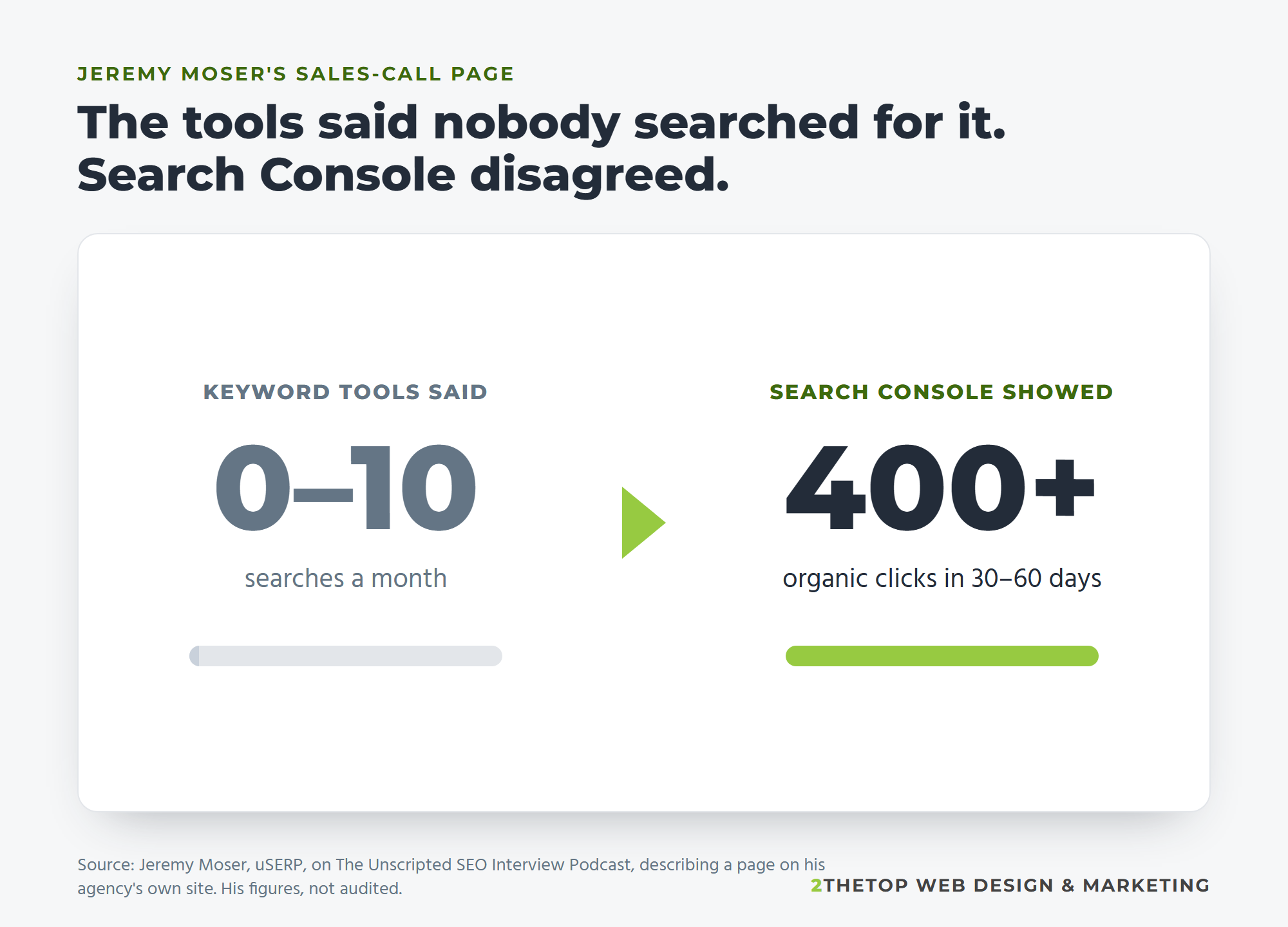
Those are Moser’s figures from his own site, not an audited study, and one page doesn’t make a rule. What it shows is how a low number in a tool can hide real demand. When a question comes up on sales calls every week, that’s evidence of searches too, and it’s evidence the tool doesn’t have. But it lines up with the precast wall story further down, and with Moser’s own conclusion:

Tools still earn their place. They’re weak at telling you what to write about and good at checking an idea you already have. We’ll get to that order below. If you want the full list of what each tool can and can’t tell you, read the 4 SEO tools you need to know.
Your sales team knows which keywords pay
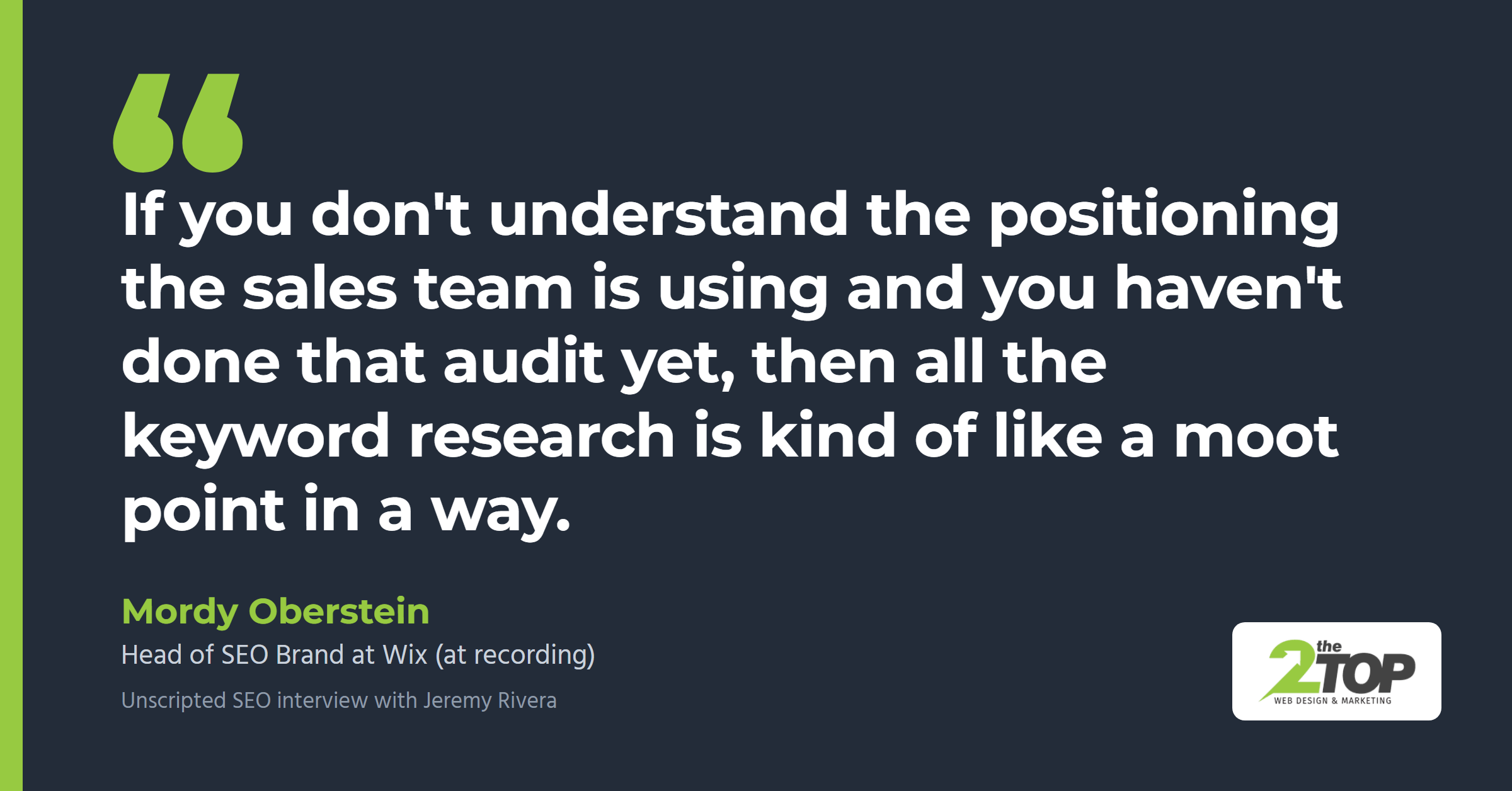
The people who sell for you know which searches lead to money, because they hear the objections and the deal-closers every week. Mordy Oberstein, head of SEO brand at Wix when we recorded, puts the sales conversation ahead of the keyword list. Before you plan content, he said: “Talk to the sales team. How is the sales team selling the product? How are they positioning it?”
Greg Digneo of Content Guppy runs this as a process for his B2B clients. When Content Guppy signs a client, the first step is an hour-long interview with the subject-matter expert. Then the team interviews the sales team, then talks to as many customers as the client allows, often three or four. When the sales team reports that prospects keep saying “we need these five integrations,” that becomes an FAQ section answering whether the product works with those five tools. Objections become comparison pages.
Here’s one of mine. For a precast concrete wall company, I interviewed the VP and the person who oversees installations, and asked what buyers ask before they sign. One answer kept coming back: they want a wall that can’t be dug under. The site never said it. The keyword tools were no help either, because nearly every search about digging under a fence is about dogs. So the plan was a page on it plus a line in the calls to action on the product pages, because it’s a reason people buy.
You don’t need a sales department to do this. Ask whoever answers the phone:
- What do callers ask in the first minute? Those are your headlines.
- What almost stops a sale? Each objection is a page or an FAQ answer.
- Which jobs do you actually want more of this season? An asphalt contractor who’d rather pave parking lots than driveways shouldn’t be chasing “driveway repair.”
- Which customers send you more work? Write for them first.
This is where keyword work starts in our SEO packages: a conversation with you and your team before anyone opens a keyword tool.
One bullet point on your site can be a customer’s whole problem
The topics you treat as a single line are often the ones your customers have the most questions about. Stephan Bajaio, CEO and co-founder of Vibe Logic and one of the original co-founders of Conductor, saw this at a healthcare company. Its content covered “change of life events” as a bullet point. Divorce was one of those events.

Stephan listed what someone going through a divorce actually wants to know. “Can I keep my spouse on my insurance? How long am I allowed to keep my spouse? Do I have to tell the insurance company about it? What if we’re just separated?” Each of those is a search. None of them shows up if you start from the company’s own outline.
The company was going to leave divorce at the bullet-point level and move on. Stephan’s question for that kind of page was blunt: “Is that really helpful? Should that really rank?” If the company knows the answers in depth, that knowledge is what should be on the page. A one-line mention gives a searcher nothing to land on, and it gives Google and AI tools nothing to quote.
Look at your own site the same way. Find the services you mention in one line and ask what a customer facing that exact situation would type. A plumber’s “water heater replacement” bullet hides “how long does a water heater last,” “water heater leaking from the bottom” and “tank or tankless for a family of four.” Each one can be a section on the service page or its own article, written the way we lay out in on-page SEO: the right words in the right places.
Check the tools after the conversation
Once you have a list in your customers’ words, keyword tools tell you which ones to do first and what kind of page will win. That’s the order: conversation, then tools, then the page.

- Talk to people. Customers, the front desk, the sales team, the installer. Record it if they’ll let you.
- Write the questions down word for word. Keep their phrasing, even when it’s “plain wrong.”
- Check each phrase in a tool. Look at rough volume, then search it yourself and see what ranks: service pages, articles, the map pack or ads.
- Match the page to what’s ranking. A service page for “near me” searches, an FAQ answer for a quick question, an article for a question that needs explaining.
- Measure it in Search Console. Give it 30 to 60 days, then look at the queries the page actually shows up for. They’ll often be closer to the customer’s words than the tool’s.
For local searches, step three should include the map results, since the map results often sit above the regular listings for those searches. Our local SEO strategies for Nashville businesses covers that side. If you’re deciding whether a keyword is worth a page at all, do the math on what a Google ranking is worth before you write. And if you’re recording those customer conversations, the same recordings can feed a month of content, which we cover in recycle, repurpose and reuse your content.
So, when did you last ask a customer what they typed into Google before they called you? What does your front desk hear in the first minute of every call? Which service on your site is one bullet point that deserves its own page? Start there, and check the tools after.
The guests in this article are all on The Unscripted SEO Interview Podcast: Daniel Alfon, Jeremy Moser, Mordy Oberstein, Greg Digneo and Stephan Bajaio. If you’d like us to run these conversations and build the keyword plan for your business, get in touch with us.
 About