
Local SEO is how your business shows up when someone near you searches for what you sell, and in Nashville that mostly means the map results, not the blue links. Here’s the proof from our own account: over the last three months, 63 of our 76 Google clicks came through our Business Profile link, which sits at an average position of 3.7. The home page, at position 24.7, got 8. If you only work on your website, you’re working on the part of local search that sends the fewest people.
We’ve taught local SEO in person since the Google Places days, at the free Nashville SEO meetup Ross Jones started. This page pulls those lessons together and runs them against our own numbers, warts included.
Your Business Profile does more work than your website
Well, the truth is that the map pack has been eating local search since 2010, when Google rolled out Place Search and rebuilt the results page around local listings. A 2011 survey of over 5,000 local business websites already had Google Places sending more visitors (33%) than Google organic search (25%). Facebook sent 2%. The names changed since then, from Place Page to Google+ Local to Google My Business to Google Business Profile, but the direction never reversed.
Here’s what our profile did between May and October 2026, straight from the owner panel:
| Metric (May to Oct 10, 2026) | Count |
|---|---|
| Profile views | 2,781 |
| Views from desktop Search | 1,189 (43%) |
| Views from desktop Maps | 938 (34%) |
| Interactions | 442 |
| Website clicks | 172 |
| Direction requests | 261 |
| Calls | 9 |
Now compare that to the website. In 16 months of Search Console data, “nashville web design” showed our site 21,267 times at an average position of 8.4 and earned 12 clicks. That’s about 0.06%. Position 8 sounds like page one, but for a query with a map pack on top, it reads more like a listing sitting low in the pack or tucked under “more places.” This very post and its older sibling showed up about 8,500 times for searches like “local seo nashville” and “nashville local seo” at positions 40 to 50, and earned 3 clicks. Ranking somewhere isn’t the same as being seen.
One caveat before you copy our math: 261 direction requests is a strange number for a web design agency, and 77% of our profile views came from desktop. Some of that is probably automated. We report it because it’s what the panel says, and because you should squint at yours the same way.
Claim, verify and mirror your profile before anything else
Back in 2011, Ross pulled up the Google Place Page for McKay Used Books in a session with their team and showed them what Google already held: 42 reviews, photos, categories, even a list of “related places” Google had decided were competitors. None of it was owner-verified. His pitch was that claiming it was free, took 5 to 15 minutes, and Google would confirm you with an automated phone call or a postcard. The steps have changed. The principle hasn’t: Google keeps a listing for nearly every business it knows about, whether or not the owner ever touched it, and an unclaimed one is Google’s guess about you.
Here’s the order Jeremy uses now, which he calls the local verification stack, or “pay Google first”:
- Put Google Workspace on your domain. It’s about thirty dollars, and the point isn’t the email. Google now has your address and your credit card.
- Get listed with the five main data aggregators as one-off citations through a citation builder. Don’t get upsold a monthly subscription. Each aggregator already fans out to between 10 and 50 sites.
- Verify Search Console, then set up Analytics and Tag Manager.
- Only then create or claim the Business Profile. Done in this order, he’s seen profiles auto-verify without the video walk-around of your signage.
Mike Martin of GBPly makes the same argument from the other side: get the website and citations to mirror each other first (name, address, hours, categories, services) and verify last. On citations he’s blunt about quality over volume: as he put it on Unscripted SEO, he’d take 10 verified, hand-built citations on the right sites over 100 mediocre ones from a mass submission tool.
Your name, address and phone number (NAP) need to match everywhere. If a directory lists your old suite number, fix it. If you’re a service-area business, don’t show a home address you don’t serve customers from; Google’s guidelines don’t allow it.
Reviews decide who gets the call, and ours stopped in 2019
This is the part we’re least proud of. Our profile has 33 reviews at 4.9 stars. The newest one is from November 22, 2019. Most of them came from meetup attendees, back when Ross was teaching a room full of Nashvillians every month. When the meetups slowed, so did the reviews. Nobody replaced the habit.
We searched “nashville web design” in Google Maps from our own front door at 615 Main St and pulled the top 10 listings:
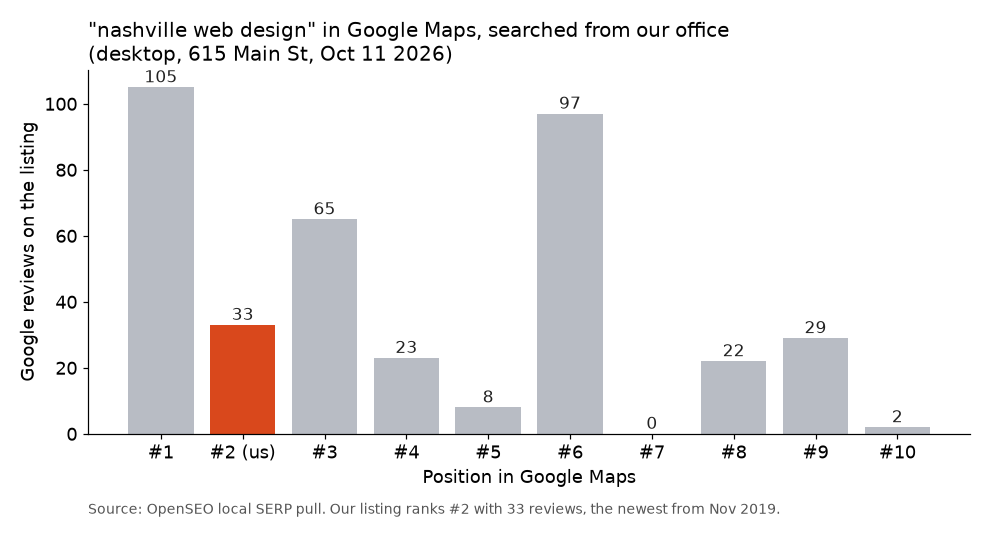
We rank #2 there. Don’t read that as a win. We’re about a block from where the search was run, so proximity is carrying us. The listings around us hold 105, 97 and 65 reviews. Move the searcher across the river to Midtown and we’d expect our distance advantage to fade, but our six-year review gap goes wherever the searcher goes.
Drew Dorenfest got into SEO through reviews for exactly this reason:
“Whoever has the most reviews, the most recent reviews is often gonna be near the top, especially if you’re apples to apples.”
Drew Dorenfest, on Unscripted SEO
And Mike Martin explains why a gap like ours costs more than the missing stars:
“If it sees lots of activity from a business and then nothing, it just assumes you’re no longer a busy business anymore and drops you through the rankings.”
Mike Martin, on Unscripted SEO
Google has warned against paying for reviews since at least 2011, and it still filters reviews it thinks were bought. Ask every happy client, make the link easy to find, and reply to every review you get. We cover the asking, the replying and the fake-review offers that will land in your inbox in our online reputation management guide.
Read your local data before you trust it
Your Business Profile panel lists the searches that showed your listing. Ours shows 433 of them for the period, and the top of the list looks great until you read it:
- “best website designer near me”: 101
- “best website designer near shelbyville”: 90
- “best web design shelbyville”: 88
- “best web designer near shelbyville”: 64
- “web design nashville”: 17
Shelbyville is 50-plus miles south of our office. About 240 searches from one small town, all phrased “best web design,” all clustered together, look like a rank-tracking or grid tool checking somebody’s position, not people shopping for a website. If we’d taken those at face value, we might have built a Shelbyville landing page for traffic that doesn’t exist.
So before you act on a local number, ask three questions. Does the location make sense for how far a customer would actually travel? Does the phrasing sound like a person or a tool? And does the number match anything else you can measure, like calls or form leads? Ours didn’t. The same goes for the profile’s search terms Google shows you: they’re a sample, and a noisy one.
Jeremy’s rule for any keyword list applies here too: sort by where the money is, not by search volume. Jonathan Schüßler, a wedding photographer who ranks in about 50 German towns, built his business on a term with roughly 10 clicks a month, because those 10 clicks were the right 10 people.
The five-step local audit we run on any Nashville business
This is the sequence we use, the same one we built for the OpenSEO local-services guide. It works for a plumber in Antioch or an agency on Main Street, and you can do most of it yourself in an afternoon.
- Profile audit. Is the listing claimed and verified? Is the primary category the one buyers search for? Do the hours, services and phone match your website word for word?
- The competitors actually outranking you. Search your main service in Maps from three spots your customers live, not from your desk. Write down who’s above you.
- The review gap. Count their reviews and note the date of their newest one. Compare yours. That gap is usually your first project.
- The rank grid. Check your position across a grid of points around your service area. A single search from your office flatters you, as ours does.
- The one fix this week. Pick the single biggest gap and close it before you touch anything else.
On your website, keep your city and state in your title tags and page copy where it reads naturally, give each real service its own page, and link the site to the profile. Don’t stuff “Nashville TN” into every sentence. Mike Martin puts the profile itself plainly:
“What a lot of SEO agencies do is they optimize it once and then they sit… It doesn’t have an end date.”
Mike Martin, on Unscripted SEO
If you want to know what a better local ranking is worth in dollars before you spend any, start with how much a Google ranking is worth. If you suspect you’ve already broken something, these small business SEO mistakes are the ones we see most. And if you’re weighing the map pack against ads, here’s when to use which channel.
Our fix this week is obvious: start asking for reviews again. What’s yours? If you’d like a second set of eyes, our SEO audit includes the Business Profile, and our SEO package keeps it moving after that. Or just tell us what you’re seeing.
 About